How to Get Dealership Towing Contracts (Higher-Margin Accounts, 2026)
The Short Answer
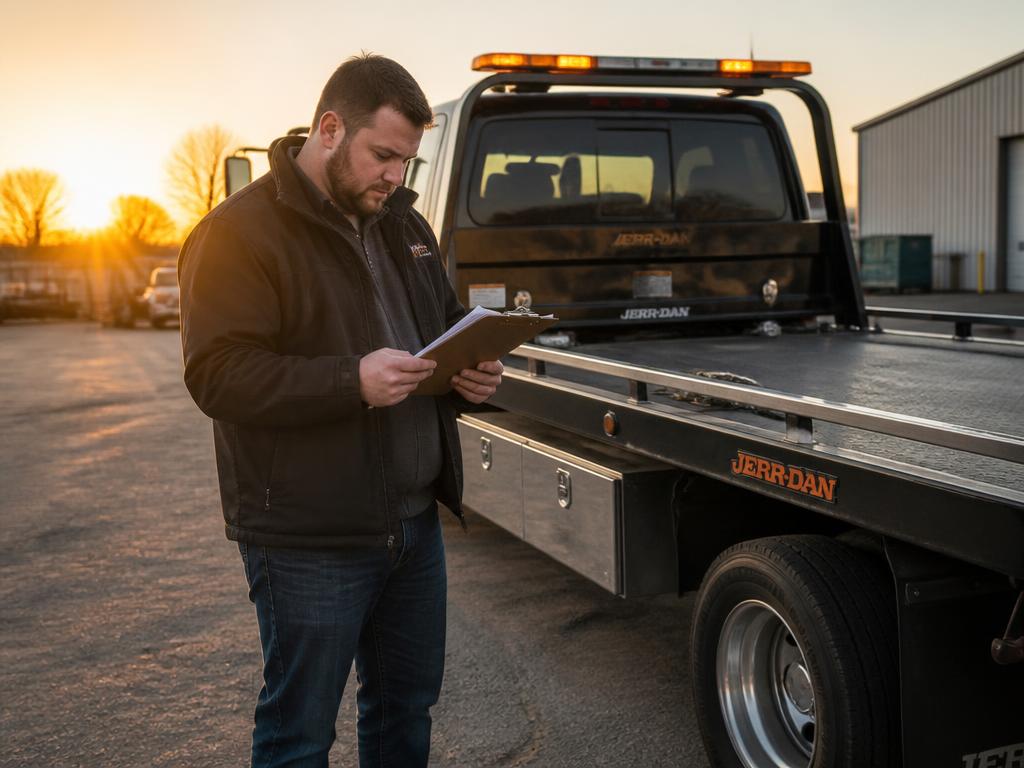
Dealer accounts are won at the service manager and used-car manager level, not the sales floor. They require a clean flatbed, $100k–$250k on-hook coverage, a COI naming the dealer, and net-30 invoicing. Expect $85–$175 per local move with steady daytime volume — better rate and better hours than motor club work, but you carry the receivable.
Free: the launch checklist with motor club preparation
Keep business setup, insurance, truck and motor club preparation in one saved checklist. Contract-specific guidance stays in this article; this is not a separate contract download.
Your requested resource opens here immediately. No card required.
Motor club calls come at 2am in the rain. Dealer transports come at 10am on a Tuesday, pay more per move, and repeat every week. That's why experienced operators chase them.
Approach the service manager and the used-car manager directly with a certificate of insurance showing high on-hook limits, a flatbed-only guarantee, and net-30 terms. Start with one no-charge or discounted trial move to prove damage-free handling.
The Four Dealer Revenue Lines
| Work type | Who orders it | Typical rate |
|---|---|---|
| Non-running trade-in pickup | Used-car manager | $95–$175 |
| Service department customer tow | Service manager | $85–$150 |
| Auction runs (buy/sell) | Used-car manager | $125–$300 |
| Dealer-to-dealer trade swaps | Sales manager | $110–$250 |
| Lot shuffles / recon moves | Recon manager | $45–$85 per unit |
What They Require Before They'll Use You
- Flatbed only — no wheel-lift on customer or inventory vehicles
- $100k–$250k on-hook, certificate naming the dealership as additional insured
- Photo condition report at pickup and delivery, every unit
- Clean, unmarked deck and soft straps for late-model and EV inventory
- Consistent driver — dealers hate a rotating cast on their lot
- Invoicing that matches their PO or RO number exactly
Get Paid Terms in Writing
Dealer work is net-30 at best and net-45 in practice. One truck financing $6k–$10k of receivables is normal. Set credit limits per dealer, invoice same-day with photos attached, and stop service at 60 days — politely, in writing.
Ready to Get Paid Calls? Start Here
The Pitch That Works
- Show up at 9:30am with donuts and a COI, not a sales pitch
- Ask the service manager one question: who do you call when your current guy is two hours out?
- Offer to be the backup first — backups become primaries within 90 days when you're faster
- Quote a flat local rate and a per-mile beyond a radius, in writing, no surprises
- Send a photo-documented invoice the same day to build the paperwork trust
How Dealer Work Changes Your Week
A healthy one-truck mix is roughly 40% motor club (fills gaps), 30% cash and PPI (highest margin), and 30% dealer and commercial B2B (daytime, predictable, invoiceable). That mix keeps the truck moving during business hours instead of waiting on club dispatch.
Frequently Asked Questions
Do I need a flatbed for dealer towing?
Effectively yes. Most dealers will not allow wheel-lift on inventory or late-model customer vehicles, and EVs and AWD units require flatbed transport.
How much on-hook insurance do dealers require?
$100,000 is the common floor, and franchise dealers with luxury inventory frequently require $250,000 with the dealership listed as additional insured.
How do dealers pay tow companies?
Almost always by invoice on net-30 terms against a PO or repair order number, not cash at the scene. Budget for the receivable.
What rate should I charge a dealership?
Below your cash retail but above motor club: a flat $85–$175 local rate plus $3.50–$5.00 per mile outside your radius is typical for light-duty flatbed work.
How many dealers can one truck serve?
Three to six active accounts keeps a single truck busy during business hours without missing ETAs.
Related Guides
See every motor clubs guideGet the full playbook — not just this page
This guide covers winning dealer and B2B accounts. The course covers the whole build: LLC → USDOT → insurance stack → motor club and contract onboarding → your first booked calls, plus scripts and rate sheets. $39, lifetime access, 13 bonuses.
Instant download after payment · Lifetime access · Secure checkout by Stripe
Free: the launch checklist with motor club preparation
Keep business setup, insurance, truck and motor club preparation in one saved checklist. Contract-specific guidance stays in this article; this is not a separate contract download.
Your requested resource opens here immediately. No card required.
Tow Truck Pro Academy
Tow Truck Pro Academy publishes state-specific training and reference material for independent light- and medium-duty tow operators — licensing, insurance, motor club onboarding, PPI contracts, and rate math.